Responsible Supply Chain: Co-Creating a Sustainable Value Chain
YFY regards its suppliers as important partners in sustainable operations and continues to embed environmental, social and governance requirements into value chain management — from raw-material procurement, supplier selection and evaluation through to product quality and customer service. Through mechanisms including responsible procurement, the Supplier Code of Conduct, risk identification and regular evaluation, we strengthen supply chain transparency and resilience, and work with our partners to enhance management capabilities in environmental sustainability, labor and human rights, health and safety, business ethics and compliance governance.
The paper industry depends heavily on raw materials such as wood chips, pulp and recovered fiber. YFY has therefore established raw-material risk management and traceability mechanisms at source, prioritizing the procurement of materials that are third-party verified and from sustainable sources. In 2025, renewable materials accounted for 96.5% of the materials used for products and packaging; 95% of raw materials procured by YFY Procurement were FSC/PEFC certified; and 100% of externally purchased imported pulp at Chung Hwa Pulp Corporation in Taiwan was certified. Green procurement of raw materials reached NT$10.3 billion for the year, representing 55% of total raw-material procurement, while local suppliers accounted for 93% of suppliers by number. YFY continues to increase local procurement and the use of recovered fiber, reducing the potential impact of raw-material sourcing on forests, ecosystems and supply stability.
Supplier management has also progressively extended from basic procurement conditions to ESG risk management. As of the end of 2025, more than 2,000 suppliers had signed the Supplier Code of Conduct and Statement of Commitment, with a 100% signing rate among new suppliers. 1,018 supplier evaluations were completed during the year, of which 1,015 were low-risk Grade A and 3 were medium-risk Grade B, with no high-risk Grade C suppliers requiring immediate improvement. The Company also continues to improve supply chain information transparency and risk-response capability through digitalized supply chain management, improvement guidance and sustainable-procurement capacity building.
Responsible management also extends to products and customers. Each business group has established quality management, customer communication, satisfaction survey and complaint-improvement mechanisms appropriate to its product characteristics, incorporating market and customer feedback into product quality, packaging, delivery, service and product development processes. In 2025, the three business groups collected a combined 3,218 valid customer satisfaction questionnaires, with overall customer satisfaction reaching 94.3%. Product and service reliability continues to be enhanced through quality management and third-party verification systems.
YFY aims to build a complete sustainable value chain spanning responsible raw materials → supplier management → risk evaluation → product and customer responsibility. This not only ensures quality, cost and supply stability, but also enables YFY to work with upstream and downstream partners to reduce environmental and social risks, translating sustainability requirements into supply chain resilience and long-term competitiveness.
Through supplier screening, regular evaluation and coaching mechanisms, YFY maintains continuous visibility into supply chain quality, delivery, cost and ESG-related risks. In addition to identifying significant suppliers by transaction importance, the Company incorporates environmental, social, governance and external risks into its management approach, so that supplier evaluation serves not only as a procurement performance management tool but also as an important mechanism for strengthening supply chain resilience and sustainability management capability.
Supplier Screening and Risk Tiering
YFY assesses suppliers on the basis of business relevance and material criticality and the potential impacts they may have on the environment, society and internal governance, while also incorporating external specific risks by country (geopolitics, regulation, infrastructure, economy), sector (industry structure, business cycle, technology, labor, energy or pollution) and commodity (supply, price, quality, raw material sourcing, deforestation and biodiversity), in order to determine each supplier’s importance and risk level on an overall basis.
In 2025 the Company had approximately 2,000 transacting suppliers; of these, 42 were identified as significant suppliers, accounting for more than 62% of annual procurement. The 42 significant suppliers comprised 29 significant Tier-1 suppliers and 13 significant non Tier-1 suppliers; procurement spend on significant Tier-1 suppliers represented 38.6% of the total. For significant suppliers, YFY maintains visibility into supply risk and enhances partner management capability through business strategy exchanges, sharing of ESG knowledge and practical experience, periodic audits and, where necessary, quarterly business reviews (QBR).
Regular Supplier Evaluation
YFY has established a Regular Supplier Evaluation Procedure, under which evaluations are conducted in principle once in the first half and once in the second half of each year. Depending on the procurement category and the nature of the cooperation, the evaluation reviews each supplier’s overall performance in fulfilling its obligations and in management, covering the following dimensions:
Product and Service Quality: reviewing product quality, service levels and conformity with procurement and usage requirements.
Delivery Timing and Quantity: assessing on-time delivery, quantity accuracy and supply stability.
Cost Management Capability: assessing cost control and transactional competitiveness.
Supplier Responsibility: incorporating supplier-responsibility and related management topics as a basis for assessing risk and the quality of cooperation.
Evaluation results are used not only to determine supplier performance but also as an important basis for identifying potential supply risks and improvement opportunities and for subsequent procurement decisions.
2025 Supplier Evaluation Results
In 2025, YFY completed 1,018 supplier evaluations, covering approximately 50% of all suppliers. Suppliers are classified into Grades A, B and C according to their evaluation scores:
No supplier was rated as requiring immediate improvement in 2025.
Supplier Risk Assessment and Audit
Risk Category
Evaluation Grade
Number of Suppliers
Low Risk
Grade A Supplier
85 points or above
1,015
Medium Risk
Grade B Supplier
Below 85 points and 70 points or above
3
High Risk
Grade C Supplier
69 points or below
0
Total
1,018
Improvement and Exit Mechanism
For suppliers whose evaluation results fall short of requirements, YFY's procurement department issues a Supplier Coaching Improvement Form, requiring the supplier to propose corrective actions, and uses a coaching mechanism to help clarify the root causes of the issues, set quantified improvement measures and track improvement results. If a supplier still fails to meet the qualifying standard after improvement, the Company may revoke its approved-supplier status based on the evaluation results and the risk of continued cooperation, forming a closed loop of evaluation → improvement → tracking → reassessment / exit in supplier management.
Supplier Sustainability Assessment and Development
YFY integrates supplier sustainability performance into its supply chain management. In addition to regular supplier evaluations, YFY uses sustainability questionnaires, supporting-document reviews, human rights risk identification and corrective-action support to assess potential negative environmental and social impacts arising from suppliers’ operations. These measures help suppliers strengthen their management capabilities, reduce operational, regulatory and reputational risks across the supply chain, and establish resilient and responsible business relationships.
Based on its Supplier Corporate Social Responsibility Code of Conduct and Due Diligence Statement, YFY references the Responsible Business Alliance (RBA) Code of Conduct and relevant sustainability assessment indicators to translate requirements concerning labor and human rights, health and safety, environmental protection, and business ethics into supplier assessment criteria. The assessment framework also incorporates sustainable procurement, information security, personal data protection, and nature-related considerations to address the characteristics and management needs of YFY’s supply chain.
1. Supplier Review and Assessment Scope
YFY’s Procurement Department and ESG Office jointly implement supplier sustainability assessments. The Procurement Department manages supplier communications, questionnaire distribution and collection, and integration with procurement management. The ESG Office supports the development of assessment criteria, reviews suppliers’ explanations and supporting evidence, and consolidates sustainability and human rights risk information.
Assessments prioritize significant Tier-1 and non-Tier-1 suppliers and are implemented in phases to progressively expand coverage. The updated Supplier Code of Conduct has been incorporated into the supplier management system for new suppliers to sign and has been communicated to existing suppliers, providing a common basis for communicating requirements and conducting subsequent assessments.
2. Sustainability Questionnaire and Evidence Review
YFY has developed a supplier sustainability self-assessment questionnaire comprising 40 questions across four areas. Each area includes fields for supplier responses, explanations and supporting evidence, as well as YFY’s review responses, scores and remarks, linking supplier self-assessment with company review.
Assessment Area
Number of Questions
Key Assessment Topics
Business Ethics and Sustainable Procurement
10
Business integrity and anti-corruption; whistleblowing and non-retaliation mechanisms; intellectual property and confidential information; personal data protection and information security; sustainable procurement; raw material traceability; conflict minerals; and sustainable materials.
Labor and Human Rights
10
Prohibition of child labor; management of identity documents and recruitment fees; employment agreements; working hours; wages and benefits; freedom of association and collective bargaining; worker grievances; and legal compliance.
Health and Safety
10
Hazard identification; emergency preparedness and fire safety; occupational injury management; personal protective equipment; ergonomic risks; equipment safety; living and dining conditions; and occupational health and safety training.
Environment
10
Environmental permits; pollution prevention and resource circularity; hazardous substances and waste; air emissions; water resources; energy and greenhouse gases; biodiversity; and legal compliance.
Suppliers must respond based on their actual practices and provide explanations and supporting evidence, such as current practices, policy or procedure names, certificate numbers, document titles, or corrective measures. Through desk assessments, YFY reviews responses and supporting documentation against assessment requirements and records its findings and any matters requiring clarification. The assessment therefore combines supplier declarations with YFY’s verification of supporting evidence.
YFY also combines document reviews and on-site assessments through its subsidiaries’ supplier audit mechanisms to examine suppliers’ management practices. Its subsidiary, YFY Consumer Products, conducts periodic supplier audits through its Quality Assurance and Procurement departments, using document reviews and on-site assessments. The audit scope covers environmental protection, occupational health and safety, labor and human rights, and information security and privacy protection. These second-party assessments, conducted by company personnel, examine whether suppliers’ actual practices meet management requirements. Joint reviews involving relevant functions and suppliers, together with corrective-action support and ongoing follow-up, help suppliers strengthen their management capabilities.
3. Assessment Scoring and Classification
Each questionnaire response is scored as follows: “Yes” receives one point, “No” receives zero points, and “N/A” is excluded from the denominator for the relevant assessment area. Each area’s score is calculated as the percentage of applicable items receiving a “Yes” response. The four areas each account for 25% of the total score. The questionnaire uses the following self-assessment ratings as an initial basis for identifying management gaps and improvement needs:
Self-Assessment Rating
Total Score
Classification
A
85 or above
Excellent
B
75 to below 85
Good
C
65 to below 75
Needs Improvement
D
Below 65
High Risk
YFY separately records review scores and remarks based on the evidence submitted by suppliers and considers findings in each assessment area, legal compliance and human rights risk information when determining subsequent improvement needs. Overall scores and individual material issues are reviewed separately to ensure that strong performance in other areas does not obscure specific environmental, health and safety, or human rights risks.
4. Human Rights Risk Identification
In addition to the sustainability self-assessment, YFY uses a separate labor and human rights risk identification form covering six topics: forced labor, working hours, wages and benefits, young workers, occupational health and safety, and freedom of association and collective bargaining.
Suppliers assess impact severity and likelihood on a scale of one to five. The two scores are multiplied to determine the risk score. Scores of 16 or above are classified as high risk, scores of nine to 15 as medium risk, and scores of eight or below as low risk. This assessment is separate from the overall sustainability self-assessment score and is used to identify potential human rights risks and inform further review and discussions on improvement measures.
5. Corrective-Action Support and Follow-Up
YFY links assessment findings with its existing supplier improvement support mechanism. Where evaluation results are unsatisfactory or individual items require improvement, the Procurement Department and relevant functions communicate management requirements to suppliers and require corrective, preventive or improvement measures. Improvement deadlines and follow-up arrangements are determined according to the nature of the issue.
Support focuses on helping suppliers clarify issues and their root causes, develop actionable and measurable improvement measures, and provide evidence demonstrating completion. Based on suppliers’ responses and follow-up results, YFY evaluates their management capabilities and suitability for continued cooperation. Where necessary, YFY takes action concerning approved-supplier status or business relationships in accordance with its supplier management procedures.
6. Supplier Development and Capacity Building
Through its Supplier Code of Conduct, explanations of sustainability requirements, ESG knowledge sharing and corrective-action support, YFY helps suppliers understand assessment procedures, evidence requirements and key management expectations, promoting the integration of sustainability requirements into daily operations.
Supplier development includes information provision and support for implementing improvements. Based on management gaps identified through assessments, YFY helps suppliers strengthen their capabilities in environmental protection, labor and human rights, health and safety, and business ethics. By combining assessment, communication and follow-up, YFY encourages suppliers to progress from meeting basic requirements to improving their sustainability performance.
To strengthen suppliers’ technical capabilities, YFY’s subsidiary, Chung Hwa Pulp Corporation (CHP), supports its suppliers Tecom and Shin Foong through an upstream digitalization support program, helping them establish predictive equipment maintenance and strengthen automation controls. This collaboration extends supplier development to equipment maintenance and process control capabilities. By providing digital technology support, CHP helps suppliers strengthen operational management and lays the foundation for further improvements in resource efficiency and sustainability performance.
7. Implementation Results and Performance Monitoring
YFY monitors assessment and development results using unique supplier counts. A supplier receiving multiple assessments or support activities is counted only once under each indicator. Based on the consolidated results for 2025, YFY identified 42 significant suppliers, of which 10 completed desk assessments, representing an assessment coverage rate of 23.8%. All 42 significant suppliers received support through supplier development measures.
Indicator
2025 Results
Total number of unique suppliers
2,000
Number of unique significant suppliers
42
Number of unique significant suppliers supported with development measures
42
Number of unique significant suppliers assessed via desk assessments
10
Number of unique significant suppliers assessed with substantial actual or potential negative impacts
0
Number of unique significant suppliers with substantial negative impacts and agreed corrective action or improvement plans
0
Number of unique significant suppliers whose business relationships were terminated due to substantial negative impacts
0
Note: Assessment coverage is calculated by dividing the number of significant suppliers assessed by the total number of significant suppliers. Findings concerning substantial negative impacts apply only to suppliers assessed during the reporting year and do not indicate that all suppliers are free of risk. Regular supplier evaluation, human rights risk identification, and sustainability desk assessments are monitored separately according to their respective scopes.
YFY will continue to expand assessment coverage among significant suppliers, strengthen evidence review, risk identification and improvement follow-up, and enhance supply chain sustainability management capabilities and resilience through supplier development measures.
Continuing to Strengthen Supply Chain Risk Management
YFY will continue to enhance supply chain transparency and risk-identification capability through supplier tiering, regular evaluation, coaching for improvement, significant-supplier management and ESG risk assessment. By establishing long-term cooperation and continuous improvement mechanisms with suppliers, quality, supply stability, environmental responsibility and human-rights management are jointly incorporated into procurement decisions, reducing the risk of operational interruption and value chain risk.
Supplier Management
YFY regards its suppliers as important partners in jointly advancing sustainable development. Beyond quality, delivery and cost competitiveness, the Company continues to incorporate environmental, social and governance requirements into its procurement and supplier management processes. Through the Supplier Code of Conduct, risk identification, tiered management, regular evaluation, coaching for improvement and sustainable-procurement mechanisms, YFY strengthens supply chain transparency, resilience and responsible governance.
Supplier Management Policy
YFY has established a Supplier Code of Conduct and Statement of Commitment, requiring suppliers to comply with requirements relating to environmental sustainability, health and safety, labor and human rights, ethics, sustainable procurement, information and communications security, and privacy protection throughout the course of cooperation. As of the end of 2025, including all newly qualified suppliers, more than 2,000 suppliers had signed commitments to comply with the Code. The Supplier Code of Conduct sets out six areas of shared commitment – legal and regulatory compliance, ethical standards, labor and human rights, health and safety, environmental responsibility, and environmental sustainability – and further extends to prohibiting conflict minerals and preventing deforestation, thereby extending supplier management from a basic transactional relationship to ESG risk management.
Supply Chain Strategy
YFY has adopted Sustainable Circularity, People-Centered and Responsible Governance as the direction for sustainable supply chain management, continuing to embed ESG requirements into procurement strategy and supplier relationships, with a focus on the following three management directions:
Advance supplier ESG collaboration and sustainable procurement, expanding opportunities in renewable energy, energy-efficient equipment and local procurement.
Increase the degree of digitalization in supply chain management to strengthen information transparency and real-time responsiveness, reducing operating and supply risk.
Provide suppliers with the necessary resources and assistance to enhance ESG awareness, capability and execution across the supply chain.
Sustainable Supply Chain Management Mechanism
YFY has established a three-phase sustainable supply chain management process, running from commitment and screening before cooperation begins through to evaluation and improvement afterwards, forming a mechanism of continuous management.
Three-Phase Management Process
Management Phase
Management Content
Phase 1 | Supplier Code of Conduct Signing
During onboarding, new suppliers must complete a supplier questionnaire and sign a vendor commitment and the Supplier Code of Conduct, committing to comply with YFY’s sustainability management requirements. Suppliers may also provide supporting evidence such as FSC or ISO environmental or social third-party certifications and upload the related documents to YFY’s supplier database. In 2025, 100% of new suppliers completed these procedures in accordance with the above requirements.
Phase 2 | Supplier Screening and Tiered Management
Each year YFY conducts an overall assessment based on business relevance and material criticality, environmental, social and governance impacts, and external specific risks by country, sector and commodity, in order to identify significant suppliers and apply tiered management. In 2025 the Company had approximately 2,000 transacting suppliers, of which 42 were classified as significant suppliers, representing more than 62% of annual procurement. For significant suppliers, YFY reduces supply-interruption and operating risk through strategy exchanges, sharing of ESG knowledge and experience, periodic audits and, where necessary, quarterly business reviews (QBR).
Phase 3 | Supplier Assessment and Improvement
During the cooperation period, regular supplier evaluations review product and service quality, delivery timing and quantity accuracy, cost management and other supplier-responsibility topics, with results used as the basis for risk analysis and continuous improvement. Where a supplier’s evaluation results fall short of requirements, the procurement unit initiates a coaching and improvement mechanism, requiring the supplier to propose corrective actions and a quantified improvement plan. If the supplier still fails to meet the standard after improvement, its approved-supplier status may be revoked.
Supplier ESG Programs
YFY integrates environmental protection, labor and human rights, health and safety, and business ethics requirements into supply chain management through supplier qualification reviews, sustainability assessments, corrective-action support, and ongoing supplier relationship management, guided by its Supplier Corporate Social Responsibility Code of Conduct and Due Diligence Statement. In recent years, YFY has further advanced sustainability assessments and human rights risk identification for significant suppliers, strengthening the connection between Code requirements, suppliers’ actual practices, and the review of supporting evidence.
1. Governance and Accountability
YFY’s Board-level Sustainable Development Committee oversees material sustainability issues, including responsible supply chain management. The ESG Office serves as the Committee’s executive secretary, coordinates implementation across management, business groups, and relevant functions, and regularly reports sustainability matters and implementation progress to the Board of Directors.
The Procurement Department and ESG Office jointly implement supplier sustainability management. The Procurement Department is responsible for the supplier management system, supplier communications, and distribution of self-assessment questionnaires. The ESG Office designs the sustainability and human rights assessment content and assists in reviewing supplementary documents submitted by suppliers. The updated Supplier Code of Conduct has been incorporated into the supplier management system and published on the corporate website. YFY is also conducting phased sustainability self-assessments and human rights risk identification for significant tier 1 and non-tier 1 suppliers.
2. Alignment of Procurement Management with the Supplier Code of Conduct
YFY links its Supplier Code of Conduct to supplier onboarding, assessment, and ongoing relationship management. Through Code acknowledgment, information collection, and review of supporting evidence, YFY assesses suppliers’ understanding and implementation of sustainability requirements. YFY also reviews pricing, delivery schedules, order changes, payment terms, and quality requirements to determine whether they could hinder suppliers’ compliance with the Code. Where conflicts are identified, purchasing arrangements are adjusted through supplier engagement and internal coordination.
Based on the updated Code, the supplier sustainability assessment questionnaire comprises 40 questions across four areas: Business Ethics and Sustainable Procurement, Labor and Human Rights, Health and Safety, and Environment. In addition to supplier self-assessments, the questionnaire includes fields for explanations, supporting evidence, and YFY’s review comments to facilitate verification of suppliers’ management systems and actual practices. A separate human rights risk identification worksheet assesses issues relating to forced labor, working hours, wages and benefits, young workers, occupational health and safety, and freedom of association and collective bargaining.
YFY’s subsidiary, Chung Hwa Pulp Corporation (CHP), also incorporates management system certifications and green labels into supplier assessments and requires suppliers to meet human rights requirements, including compliance with labor laws and the prohibition of child labor. Through these practices, YFY continues to strengthen alignment between its Supplier Code of Conduct and procurement management procedures.
3. Corrective Action and Exclusion of Non-Compliant Suppliers
For suppliers with unsatisfactory assessment results, breaches of commitments, or non-compliance with contractual requirements, YFY’s Procurement Department issues a Supplier Coaching Improvement Form and requires corrective and preventive measures to be submitted within a specified timeframe. Through guidance and follow-up, YFY helps suppliers identify underlying issues and develop corrective actions with measurable outcomes. If suppliers refuse to implement improvements or remain unqualified after the prescribed improvement period, YFY suspends or revokes their approved-supplier status and terminates or rescinds the relevant contracts in accordance with applicable procedures and contractual terms.
YFY’s subsidiary, CHP, requires suppliers that fail to meet environmental requirements or violate relevant rules to make improvements within a specified timeframe and monitors their progress. Cooperation is terminated if the necessary improvements are not completed. YFY’s subsidiary, YFY Consumer Products, manages supplier non-conformities through document reviews, on-site audits, periodic performance evaluations, and ongoing corrective-action support. Supplier relationships may be terminated where requirements remain unmet despite such support.
4. ESG Performance in Supplier Selection
In supplier selection and raw material procurement, YFY gives preference to suppliers that provide third-party-certified and traceable raw materials. Certifications such as FSC and PEFC, together with source management, help reduce environmental risks in forest-based raw material supply chains.
YFY’s subsidiary, CHP, incorporates environmental requirements into its supplier procurement criteria and prioritizes cooperation with suppliers that provide certified, traceable raw materials. Supplier compliance and the effectiveness of corrective actions are also considered when determining whether to continue a relationship. Suppliers that demonstrate effective improvements and meet requirements may be considered for further cooperation opportunities.
Alongside environmental procurement preferences, YFY uses its Supplier Code of Conduct and sustainability assessment tools to evaluate supplier management practices relating to labor and human rights, health and safety, business integrity, information security, and privacy protection. These practices strengthen the connection between supplier selection and sustainability management.
5. Capacity Building for Buyers and Internal Stakeholders
Through professional exchanges and cross-functional collaboration, YFY helps procurement personnel and relevant employees understand supply chain sustainability requirements. The ESG Office and Procurement Department jointly discuss revisions to the Supplier Code of Conduct, the integration of sustainability and human rights indicators into supplier assessments, and responsibilities for questionnaire distribution and supplementary document review, translating sustainability requirements into practical implementation steps.
The questionnaire’s topic descriptions, evidence requirements, and review fields provide a common reference for supplier management activities and support relevant personnel in collecting and reviewing information. YFY will continue to strengthen practical guidance and capacity building for procurement personnel on ESG risk identification, corrective-action follow-up, and the use of assessment results.
Sustainable Procurement and Supply Chain Digitalization
YFY continues to incorporate sustainability into its procurement systems, building long-term partnerships through transparent, fair and ethical procurement standards, and encouraging suppliers to invest in innovation, environmental improvement and social responsibility. In 2025 the Company continued to advance its digital supply chain collaboration system, with the management direction of enabling more than 85% of suppliers to share information and conduct online business activities through a digital platform, improving the timeliness and transparency of supply chain information. At the same time, YFY continues to increase the green procurement ratio for raw materials: in 2025 the green procurement ratio for wood chips exceeded 92%, while green procurement for pulp remained at 100%.
Sustainability Literacy and Capacity Building
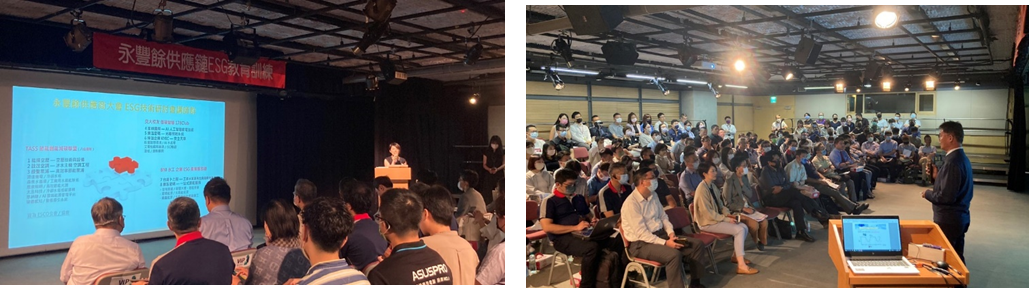
In addition to managing suppliers, YFY also strengthens the professional capabilities of its own procurement personnel on supply chain sustainability topics. In 2025, external partners including banks, pulp agents, starch manufacturers, transport and customs brokers, and equipment suppliers were invited to exchange professional knowledge, helping procurement personnel develop command of topics relating to markets, logistics, raw materials and sustainable procurement. The training completion rate reached 100% for the year.
Raw Material Procurement
YFY relies primarily on fiber-based raw materials such as wood chips, pulp and recovered paper as its main production resources. Raw-material sourcing affects not only product quality and supply stability but also forest resources, biodiversity, carbon management and supply chain resilience. The Company therefore continues to advance responsible and green procurement, giving priority to raw materials whose sources are traceable and which carry third-party certification or meet sustainability management requirements, while reducing the environmental and operational risks of raw-material sourcing through recovered fiber, local procurement and supplier collaboration.
Responsible Raw Materials and Renewable Materials
In 2025, renewable materials accounted for 96.5% of the raw materials used for the products and packaging of YFY's three business groups, consisting mainly of wood chips and timber, pulp, base paper, cartons, paperboard, recovered paper and starch; recovered paper accounted for approximately 36.2% of raw material use. More than 90% of the raw materials used by the Containerboard and Packaging Group for pulp production came from recovered paper, continuing to reduce demand for virgin resources through the use of recycled fiber. Principal raw-material procurement volumes in 2025 included approximately 920,000 metric tons of wood chips, 303,000 metric tons of pulp, 1.649 million metric tons of recovered paper, and 1.183 million metric tons of base paper, cartons and paperboard. Through dual-track management of virgin and recovered fiber, YFY continues to improve the efficiency of circular raw-material use while maintaining product quality and supply stability.
2025 Raw material usage
Raw Material Use
Unit: metric tons
Material Category
Material Items
Forest, Pulp & Paper Group
Containerboard and Packaging Group**
Consumer Products Group
Total
Renewable Materials
Wood chips / wood, pulp, base paper / cartons / paperboard, recovered paper, starch
1,614,804
2,769,374
181,707
4,565,885
Non-Renewable Materials
Other raw materials (limestone, mineral sand, industrial salt, chemical raw materials, etc.) and packaging materials
65,656
83,881
17,567
167,104
Total
1,680,460
2,853,255
199,274
4,732,989
* Data scope: All production sites listed under “Entities Included in the Report.”
** Renewable materials accounted for 97.3% of total raw material use at the Taiwan and Vietnam operations of the Containerboard and Packaging Group.
2025 Procurement of raw materials(Unit: Tons)
Raw Material Procurement Volume
Unit: metric tons
Raw Material Category
Weight
Wood Chips
920,328
Pulp
303,402
Recovered Paper
1,648,658
Base Paper, Cartons, and Paperboard
1,183,110
Surfactants
2,443
Total
4,057,941
* Data scope: All production sites listed under “Entities Included in the Report.”
Forest Certification and Raw Material Traceability
To reduce the risks of illegal logging, forest degradation and biodiversity loss that may arise in the wood and pulp supply chain, YFY gives priority to procuring forest raw materials carrying third-party certification such as FSC or PEFC, and continues to improve raw-material traceability. In 2025, 95% of raw materials procured by YFY Procurement were FSC/PEFC certified; of these, 95.71% of wood chips purchased by Chung Hwa Pulp Corporation in Taiwan were FSC/PEFC certified, and 100% of externally purchased imported pulp was certified. The Company continues to strengthen management of forest raw-material sources through Chain of Custody certification and supplier documentation management. YFY also continues to monitor international trends in forest and supply chain regulation, strengthening its capacity to respond to forest risks and international market requirements through certified raw materials, source traceability and supplier management.
Recovered Fiber and Circular Procurement
Recovered fiber is an important raw-material source for YFY's circular economy. The Company works with licensed resource recycling operators to establish source-management mechanisms for recovered paper, and keeps paper fiber circulating throughout the product life cycle through recovery, reprocessing and reuse. In 2025, recovered paper procurement totaled approximately 1.649 million metric tons, continuing to serve as an important raw-material source for industrial paper and related products. Increasing the proportion of recovered fiber used not only reduces the consumption of virgin resources but also lowers the need for final disposal of waste paper, returning paper fiber to the production cycle.
Green Procurement
YFY continues to incorporate environmental criteria into procurement decisions, giving priority to raw materials and products that are environmentally certified, renewable or recyclable. In 2025, green procurement of raw materials reached NT$10.3 billion, representing approximately 55% of raw-material procurement. The Company will continue to raise the green procurement ratio for wood chips, pulp and other principal raw materials, and to reduce forest and environmental risks through third-party certification and supplier collaboration. In 2025, the green procurement ratio for wood chips exceeded 92%, while the green procurement ratio for pulp was maintained at 100%.
Local Procurement
In addition to international raw-material sources, YFY continues to explore local procurement opportunities in order to shorten supply chain distances, strengthen supply stability and support economic development in the regions where it operates. In 2025, local procurement accounted for approximately 52% of procurement spending, and local suppliers accounted for more than 93% of suppliers by number. The Company will continue to increase opportunities to work with local suppliers, while giving due regard to quality, cost, supply capability and sustainability conditions.
Raw Material Risk Management
In response to external risks including geopolitics, natural disasters, war, logistics disruption and raw-material price volatility, YFY continues to strengthen raw-material supply management, including:
Monitoring international market conditions and raw-material supply and demand trends;
Consolidating Group procurement of key raw materials to improve bargaining position and supply stability;
Using the supply chain management platform to track demand forecasts and inventory status;
Working with licensed resource recycling operators to manage recovered-fiber sources;
Deepening strategic collaboration with key international suppliers;
Strengthening logistics, warehousing and supply chain information management;
Continuing to digitalize procurement processes to improve the timeliness and accuracy of information.
Through responsible procurement, third-party certification, the use of recycled raw materials and risk management, YFY continues to build a circular management model spanning raw-material sourcing – procurement – production – recovery and reuse, so that raw-material management addresses forest conservation, resource efficiency, supply stability and long-term competitiveness at the same time.
Product Responsibility
YFY regards product quality, product safety and the customer experience as an important part of a responsible supply chain, and continues to reduce the potential environmental and social impacts of its products across raw-material selection, product design, manufacturing, product information and safe use, customer service and life-cycle management.
As an investment holding company, YFY does not sell products directly to end customers. Its Forest, Pulp & Paper Group, Containerboard and Packaging Group and Consumer Products Group each establish customer communication, satisfaction survey, complaint-handling and product/service improvement mechanisms according to product characteristics, customer type and market conditions, with results consolidated and tracked by YFY.
Product Safety and Quality Management
YFY incorporates product safety and environmental considerations into its product development and manufacturing processes, managing raw-material composition, production processes, logistics, product use and end-of-life, and continuing to increase the use of renewable raw materials, resource efficiency and circular value.
In terms of product safety, YFY documents in detail the composition and physicochemical properties of its raw materials and products, tests for restricted substances and applies legally required product labeling and third-party testing. Depending on product characteristics, this management covers domestic and international requirements including the EU Restriction of Hazardous Substances Directive (RoHS), the EU Substances of Very High Concern (SVHC) list, food-grade requirements (FDA and TFDA), the Toxics in Packaging Clearinghouse (TPCH) and non-fluorescence testing; YFY paper products also pass government Eco-label certification. Suppliers are also required to provide raw-material test reports, and plants conduct regular sampling inspections to strengthen product safety management. In 2025, there were no complaints or warnings relating to the health and safety of products, services and customers, product labeling or marketing communications.
Customer Communication and Service
YFY's customer-relationship management principles are rapid response, transparent handling and continuous improvement, providing diverse and traceable communication channels according to the needs of different customers and consumers. Through customer service hotlines, online real-time and intelligent customer service, email, online contact forms, business visits, customer meetings, product briefings and other on-site exchanges, each business group receives questions and suggestions relating to products, purchasing, use and service, allowing customers to select the channel appropriate to their needs and the urgency of the matter. Customer-service and sales records also serve as the basis for case tracking and subsequent product and service improvement.
Customer Service and Complaint Handling Process
YFY has established mechanisms for the intake, analysis, improvement, response and tracking of complaint cases. After a customer raises an issue, customer service or the sales unit confirms the issue and the customer’s requirements and records the case, which is then assigned according to its nature to quality assurance or the relevant responsible unit for cause analysis and the development of improvement and preventive measures. YFY Consumer Products has also established Customer Complaint Handling and Consultation Service Procedures, providing immediate consultation and a complete grievance process to protect consumer rights and continuously optimize the customer product experience.
On handling timelines, the receiving unit communicates the expected schedule by case type: general inquiries are answered immediately or within one working day by customer service or sales, while for complaints the quality-assurance or responsible unit provides a progress update after preliminary analysis, ensuring the handling process is transparent to the customer.
Handling results are explained to the customer by customer service or the sales unit, covering the cause, improvement measures and subsequent handling, and the case is closed only after customer confirmation. Each business group follows its quality-management and complaint-handling systems, with reference to ISO 10002 guidance on customer satisfaction and complaint handling. When production-site quality-management systems undergo third-party verification against standards such as ISO 9001, customer satisfaction, complaint handling and corrective and preventive measures are also included in the audit scope.
Service Improvement for Customers with Disabilities and Elderly Customers
For consumer products and other products that may reach end users, YFY provides diverse and accessible customer-service channels to reduce communication barriers for persons with disabilities, older customers and people unfamiliar with digital tools. Telephone hotlines, email, online contact forms, online real-time customer service, and business and on-site service contacts allow customers and consumers who cannot conveniently use a single channel to select an appropriate method to obtain product and service information and to provide feedback on their experience and views.
Customer Satisfaction Management
In line with their differing operating and market characteristics, the business groups regularly collect the product and service experience of customers and primary brand purchasers using paper questionnaires, electronic questionnaires and online surveys. Surveys are conducted annually, semiannually, quarterly or monthly according to each business group’s needs, serving as an important basis for assessing the quality of products, services and customer relationships.
In 2025, the three business groups returned a combined 3,218 valid questionnaires, of which 3,033 met the satisfaction standard defined by each business group, for overall customer satisfaction of 94.3%, with operating-site coverage of the survey data reaching 100%. Overall customer satisfaction has remained above 90% for the past four years and above 94% in both 2024 and 2025.
Customer Service Process
Customer feedback via 0800 hotline
Customer Relations and Market Research Division
Case classification
Inquiry
Response and explanation
Case closed
Complaint
Quality Assurance unit
Cause analysis and improvement measures
Customer response and product replacement
Case closed
Customer Satisfaction Survey Process
Customer Relations and Market Research Division
Annual customer satisfaction survey
Survey report
Average satisfaction of 4 points or above
Continue tracking and improving
Average satisfaction of 3 points or below
Develop improvement measures
Satisfaction is scored on a 1–7 point scale.
Turning Customer Feedback into Product Improvement
Customer feedback is not only the end point of handling a service case but also the starting point for continuous product and service improvement. Each business group periodically consolidates customer satisfaction surveys, customer-service records, business visits, complaint cases and market feedback as the basis for improvements in product quality, delivery, packaging design, service processes and product development.